The seed certification service
6 de August de 2025
09:39

Notes on increasing the rate of certified seed use.
Ing. Gerardo Villalva Ramírez
Manager, GVR SAC Certification Company
Various efforts toward achieving food security are geared toward increasing farmers’ competitiveness. To this end, the Ministry of Agriculture, Livestock, and Livestock (MIDAGRI) uses highly relevant indicators in its agricultural producer registry (1), such as: access to irrigation systems, agricultural credit, technical assistance, cell phone service, and the use of certified seed.
The use of certified seed is considered one of the fundamental pillars for increasing competitiveness and achieving food security; unfortunately, our national average only reaches 13.18% certified seed use.
The use of certified seed is the result of carefully coordinated work.
Countless experiences have taught us that building a sustainable supply of certified seed is the result of carefully coordinated work between the public and private sectors. Isolated efforts by the public sector to finance seed production activities or regulate seed production without the participation of the private sector are inevitably doomed to failure. Similarly, private sector initiatives that do not receive state support, for example through promotional measures such as updated regulations or preventive inspections against informal trade, will be hampered, discouraging private sector participation.
Even more serious is the observation that the state sometimes becomes a competitor with the private sector in seed production and distribution activities.
The most successful experience in Peru to date has been the construction of the supply/demand for certified rice seed, which currently reaches 20,000 tons of certified seed, representing almost 60% of the national seed requirement. To achieve this, the state initiated efforts in research (in the 1970s, 1980s, and 1990s) and production (in the 1970s and 1980s). It was progressively supplanted by the private sector, which began production in the 1990s and then invested in research to develop new varieties in the 2010s.
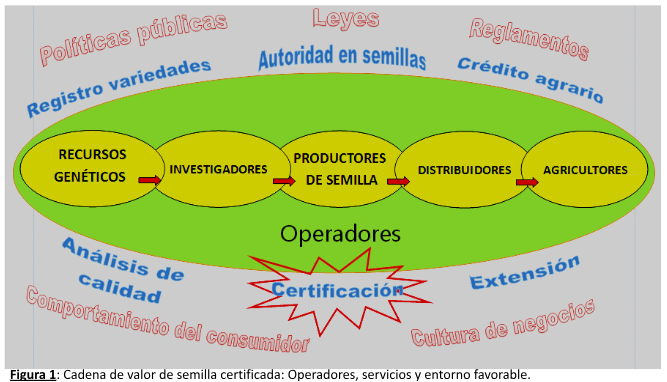
After 50 years, the certified seed value chain has been defined, comprising five activities: genetic resource management, research, production, distribution, and use (Figure 1).
To ensure these activities remain well-coordinated, essential services were needed, such as variety registration (mandatory for seed of all species) and certification services (mandatory for rice seed); additionally, credit, extension, and access to agricultural inputs were important.
The certified rice seed supply system has provided us with valuable lessons for beginning expansion into other species; our country now has the necessary foundations for the establishment and development of value chain activities and services for other species in much shorter periods of time. We already have a favorable environment, such as public policies, laws, and regulations that promote the participation of private capital. However, we still need to update and incorporate quality parameters for new species.
A major outstanding debt for the State is leadership in the seed sector through a Seed Authority that is solid in terms of human capital, infrastructure, and resources, and that is also capable of promoting institutionalization in the sector by assuming the technical secretariat of the National Seed Commission.
Each agricultural species must be analyzed separately, focusing on the state of the Genetic Resources, which are the input used by researchers. Based on this work, the seed supply chain can gradually reduce the gap in access to certified seed.