Rice varietal options are numerous in Peru today, although only a few varieties are favored by farmers, industry, and the consumer market. These include HP102FL – El Valor and FEDEARROZ 60, which have a significant presence on the Peruvian coast and jungle, and INIA 508 – Tinajones, whose cultivation occupies significant areas in some coastal valleys. These three varieties account for approximately 75% of the national land area dedicated to rice cultivation. However, in the current environment of high climate variability and high production costs, it is important to have alternative varieties that offer advantages, whether in terms of productivity, earliness, quality, or stability (adaptability, resistance to biotic factors, and tolerance to abiotic factors), at the national, regional, or local level.
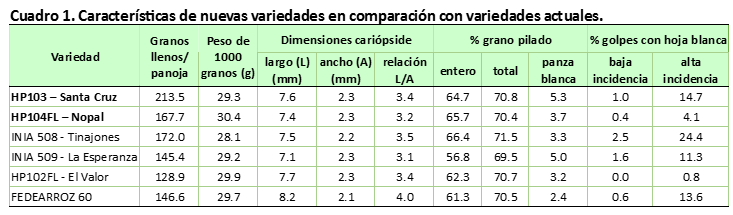
Along these lines, Hacienda El Potrero SAC has developed two new varieties called HP103 – Santa Cruz and HP104FL – Nopal. The first of those mentioned is currently the shortest-season irrigated rice variety in the country, a few days earlier than INIA 508-Tinajones, and has a high yield potential, mainly due to its high number of filled grains per panicle, higher than that of most cultivated varieties. It is also less susceptible to white leaf virus than that variety. The grain of HP103-Santa Cruz is long and thin, similar to that of INIA 508-Tinajones in shape and cooking, but heavier (see Tables 1 and 2). Due to its short season, it is better suited to direct seeding conditions, and its cultivation is recommended primarily for second-season plantings on the coast.
HP104FL – Nopal is a mid-season variety, approximately one week earlier than HP102FL – El Valor, with a high level of resistance to hoja blanca virus (Table 1) and its insect vector, and high yield potential under conditions on the north coast, in the jungle and high jungle (Table 2). Its whole milled grain yield is high, and its grain dimensions and cooking are similar to IR – 43. It is widely adapted and is recommended for planting in irrigated rice under the transplant system in all rice-growing valleys of Peru, both on the coast and in the jungle.